Khata in Karnataka: What Buyers Must Check Before Paying an Token Amount??
If you're buying property anywhere in Karnataka in 2026 you've probably run into three confusing terms: A-Khata, B-Khata, and E-Khata. They're often used as if they mean the same thing. They don't, and mixing them up before you hand over token money can cost you a loan, a resale, or years of legal cleanup. This applies whether the property is in Mysuru, Mangaluru, Hubballi-Dharwad, Belagavi, a small town municipality, a Gram Panchayat village, or Greater Bengaluru every civic body in the state runs some version of this system, and the risks are the same everywhere.

What is a Khata?
A
Khata is not a title document. It's a municipal (or panchayat) tax record that
identifies a property and names the person liable to pay property tax on it. It
confirms the property is entered in the local body's books it does not
prove ownership. Ownership is established separately, through a registered sale
deed and an unbroken title chain, which only a lawyer's title-search can
verify.
Two
related documents matter here: a Khata Certificate (a short confirmation
the property is entered in your name) and a Khata Extract (a detailed
record of dimensions, land use, and assessed value, used for due diligence and
resale).
Every local body in Karnataka issues its own Khata
Bengaluru
is only one district out of 31 in Karnataka, but it dominates the online
conversation around Khata because of transaction volume and because it was the
first place e-Khata became mandatory. The underlying system, however, exists
statewide, administered locally:
- City corporations
— Mysuru, Mangaluru, Hubballi-Dharwad, Belagavi, Kalaburagi, Ballari,
Davanagere, Shivamogga, Tumakuru, Vijayapura, and others each maintain their own Khata records and
their own e-Khata rollout, under the Karnataka Municipal Corporations
Act. Mangaluru City Corporation, for example, has run its own
e-Aasthi-based system since 2020, well before this became a statewide
talking point, and issues e-Khata through its own citizen portal. Mysuru's
Khata is issued by the Mysuru City Corporation (MCC) for city limits, and
by local Gram Panchayats for its suburban and village fringes.
- City Municipal Councils (CMCs) and
Town Municipal Councils (TMCs) — smaller towns
across the state have their own khata process through their respective
municipal council, typically with a different portal, fee structure, and
timeline than any city corporation.
- Development authorities
— sites allotted by authorities such as BDA (Bengaluru) or similarly
structured urban development authorities elsewhere maintain their own
khata equivalent allotment and transfer records, separate from the city
corporation process.
- Gram Panchayats (rural and
peri-urban Karnataka) the majority of Karnataka's
land area doesn't use "Khata" in the strict municipal sense at
all. It runs on e-Swathu, which issues Form 9 and Form 11/11A
the panchayat-level equivalent of a
Khata administered by the Panchayat
Development Officer (PDO), not a municipal commissioner. If you're buying
a village site or a plot on the edge of a growing town, this is very
likely the system that applies, not e-Aasthi.
- Greater Bengaluru (formerly BBMP, now GBA) — covered in detail below, because its 2025 restructuring and 2026 conversion drive make it a useful worked example, but it is one instance of the state-wide pattern, not the whole picture.
The practical point: the legal logic A vs B classification, and digitisation not equalling an upgrade is identical everywhere in Karnataka. What changes from place to place is which office you deal with, which portal you use, what the fee schedule looks like, and how fast applications get processed. Always confirm the correct authority for your specific property's location before assuming a specific process or portal applies.
A-Khata vs B-Khata: a legal classification, not a format
This
is the distinction that actually affects your rights, and it applies
identically whether the local authority is a city corporation, a municipal
council, or a Gram Panchayat's Form 9/11 register:
- A-Khata:
The property is fully compliant it has sanctioned building plans, an
occupancy certificate where applicable, and no zoning violations. A-Khata
properties qualify for home loans from major banks and can be resold or
have building plans approved without friction.
- B-Khata: The property has some irregularity unauthorized construction, deviation from sanctioned plans, an unapproved layout, or land not yet converted for non-agricultural use. B-Khata properties are entered in a secondary register purely so the local body can still collect tax. You can pay property tax on a B-Khata property, but you generally cannot get a building plan approved, and most major banks will refuse or heavily restrict a home loan against it.
A-Khata vs B-Khata vs E-Khata: the difference at a glance
|
Aspect |
A-Khata |
B-Khata |
E-Khata |
|
What it is |
A legal
classification: fully compliant property |
A legal
classification: property with an irregularity |
A format the digital
version of an existing Khata record |
|
Legal compliance |
Sanctioned building
plan, occupancy certificate (where required), no zoning violations |
Unauthorized
construction, deviation from sanctioned plan, unapproved layout, or
unconverted land |
Same compliance
status as the underlying A or B Khata — digitising changes nothing |
|
Home loan eligibility |
Eligible with major
banks |
Generally refused or
heavily restricted by major banks |
No independent
effect; loan eligibility still tracks the A/B status underneath |
|
Building plan
approval |
Can be approved |
Cannot normally be
approved |
Not applicable by
itself depends on A/B status |
|
Property tax |
Paid and recorded on
the primary register |
Paid and recorded on
a secondary register (kept mainly for tax collection) |
Same e-Khata just
moves the record online |
|
Registration (sale
deed) |
Straight forward |
Possible but the
deviation/irregularity carries over to the buyer |
Now mandatory in most
urban local bodies as the format used to register a sale regardless of
whether the underlying property is A or B |
|
Resale |
Easy, no friction |
Harder; buyers and
lenders scrutinise it |
Doesn't make resale
easier on its own if the property is still B-Khata |
|
How to check it |
Khata
Certificate/Extract from the local body (or Form 9/11 in Gram Panchayat
areas) |
Same, but flagged
"B" in the register |
Available for
download from the relevant online portal (e-Aasthi or the local body's
equivalent) |
|
Converts to the
other? |
N/A |
Can be converted to
A-Khata by clearing irregularities, paying betterment charges, and passing
scrutiny |
Not a conversion path
itself an e-Khata generated on a B-Khata property is still a B-Khata until
formally upgraded |
The
one-line summary: A vs B tells you whether the property is legal; E tells
you whether the record is on paper or online. They answer two completely
different questions, and neither one implies the other.
Where E-Khata fits in and the mistake buyers make??
E-Khata
is not a third category of property. It is simply the digitised,
electronic version of whichever Khata record already exists increasingly issued
through the state's e-Aasthi software framework, which various city
corporations and municipal bodies across Karnataka have adopted (with local
customisation) to consolidate ownership, ward, property-identification, and tax
data into one online record.
The
critical point buyers miss, wherever in Karnataka they're buying: digitising
a record does not upgrade its legal status. If a property was a B-Khata
property, generating an e-Khata for it produces a digital B-Khata it
remains a B-Khata until it is formally converted to A-Khata. Seeing
"e-Khata available" on a listing tells you the record has been
digitised; it tells you nothing about whether the underlying property is
legally compliant. Always ask, and confirm on the relevant portal, whether the
digitised record is an A or a B Khata.
For
an existing property, the local body typically first generates a draft
e-Khata auto-populated from old records; the owner must then complete an
Aadhaar-based eKYC to convert it into a final e-Khata only the final
version is what banks and the sub-registrar's office will accept.
Rollout
speed and reliability vary by city. Mangaluru, for instance, saw e-Khata
issuance delays into early 2026 due to software and data-mismatch problems,
even after the state pushed to make e-Khata mandatory for registration across
urban local bodies a reminder that "e-Khata mandatory" doesn't mean
"e-Khata instantly available" everywhere in the state at the same
pace.
Your pre-advance checklist (applies anywhere in Karnataka)
Before
you pay any token or advance amount, verify each of the following independently
not just from what the seller or broker tells you and adapt the specific
portal/office to wherever the property actually is:
1. Khata
classification (A or B); confirmed with the local
authority (city corporation, municipal council, or Gram Panchayat), not from
the sale brochure.
2. Khata
Certificate and Extract, or the equivalent Form 9/Form
11 if the property is under a Gram Panchayat; cross-checked against the
property's actual dimensions and survey number.
3. Encumbrance
Certificate (EC); for at least the last 13–15 years, to
rule out pending loans, litigation, or disputed transfers.
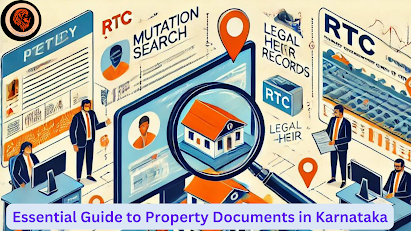
4. RTC/Pahani
and mutation records; via the Bhoomi portal, especially for
sites converted from agricultural land.
5. Sanctioned
building plan and Occupancy Certificate (OC); mandatory for
A-Khata status and for loan eligibility.
6. Property
tax receipts; recent and paid up, with no default
entries.
7. Sale
deed and title chain; checked by an independent property
lawyer, since Khata (or Form 9/11) is not proof of ownership.
8. Which
local body actually has jurisdiction; confirm the correct
city corporation, municipal council, development authority, or Gram Panchayat
for the property's exact location, especially in areas recently reorganised or
on urban-rural boundaries.
9. If
it's B-Khata: real conversion eligibility check whether a
conversion window is currently open for that specific local body, and get any
seller promise of "upcoming conversion" in writing with a timeline.
10.
Loan pre-approval from your bank;
before paying advance, since many lenders will not finance a B-Khata property
regardless of what the seller claims.
Bottom line
Treat
"A-Khata vs B-Khata" as the legal question and "E-Khata" as
the format question they're independent everywhere in Karnataka, and a slick
digital certificate can still sit on top of an unresolved B-Khata problem,
whether the property is in Bengaluru, Mysuru, Mangaluru, a smaller town, or a
village under Gram Panchayat jurisdiction. Identify the correct local authority
for your property, verify classification and title independently through that
authority's portal, get a lawyer's title opinion, and only then pay your
advance.
"Knowledge Is Power, And Service Is a Blessing."—
Adv. Sowbhagyalaxmi S H
(This article is for general informational purposes and does not constitute legal advice. If you're facing a dispute involving electronic communications, consult a qualified lawyer familiar with the specifics of your situation.)


Comments
Post a Comment